 Labs
LabsGameplay
Difficulty comes from the grid — size, word count, allowed directions — never from vocabulary rarity. Rarer words do not make a word search harder: the player is pattern-matching against a visible bank, not recalling vocabulary.
The rule everything else answers to
There is no fail state inside a puzzle.
No countdown. No penalty for a wrong drag. No way to lose a puzzle currently being played. A wrong selection simply fades out — no buzz, no counter, nothing recorded.
If a proposed feature introduces one, it is wrong regardless of how standard it is in other puzzle games. The rule is about the puzzle, not the app: a progression layer sits on top, but every mechanic in it lives between puzzles. Challenge you choose is fun; difficulty imposed mid-puzzle is not.
The Three Presets
Fixed, and not player-editable. All variety comes from themes and from the progression layer.
Easy
Phone portrait and up
- Grid
- 11 × 11
- Words
- 8
- Word length
- 4–9
- Directions
- 3 — → ↓ ↘
- Intersection bias
- 0.30
- Target density
- 0.32 – 0.50
Medium
Large phone, any tablet
- Grid
- 13 × 13
- Words
- 12
- Word length
- 4–11
- Directions
- 6 — → ↓ ↘ ↗ ← ↑
- Intersection bias
- 0.60
- Target density
- 0.38 – 0.56
Hard
Tablet only
- Grid
- 15 × 15
- Words
- 16
- Word length
- 4–13
- Directions
- 8 — all eight
- Intersection bias
- 0.90
- Target density
- 0.42 – 0.60
maxLen is geometric, not a difficulty lever
It is grid size minus two, so a word always has enough legal slots to place — and every word in the corpus stays reachable at every difficulty. Narrowing the bands by difficulty would silently put part of the vocabulary out of reach.
Long words are also the easy ones to spot: a distinctive letter run stands out of the noise where a four-letter word hides in it.
minLen is 4, not 3
Two crossing bank words can accidentally spell a third three-letter word using only placed letters — which has no filler cell to re-roll, and so forces a full regeneration.
Measured at 1.5% of Easy puzzles against a 1% budget; Medium and Hard, which already started at 4, showed zero such failures in 1,000 seeds each. Raising the floor removes the cause rather than absorbing it.
The accidental-duplicate scan
Filler letters can accidentally spell a bank word a second time somewhere else on the board. Selecting the “wrong” correct answer is genuinely infuriating, so every generated grid is scanned for it and re-rolled — required from day one, and covered by a 200-seed test. It is easy to skip and expensive to retrofit, which is exactly why it was built first.
The Puzzle Screen
The grid is always a centered square sized to min(width, height) minus padding, so it never distorts. The word bank is a right rail in one or two columns; in portrait it moves below the grid and flows into three.
Selection snaps to a ray
Drag from the first letter to the last. During the drag the app snaps to the nearest of the eight rays from the anchor cell and highlights the straight run to the projected endpoint — the player aims rather than traces. Release commits.
Tap-first-then-tap-last is also supported. It is better on a 15×15 grid where a drag spans most of the screen, and it is the accessible path.
Cell sizing, and the only thing ever dimmed
Cell size is the grid box divided by N, with a 32dp minimum — a touch target rule. On a tablet in landscape that yields roughly 50dp cells at 15×15.
| Grid | Width needed | Fits |
|---|---|---|
| 11 × 11 | ~352dp | Phone portrait and up |
| 13 × 13 | ~416dp | Large phone, any tablet |
| 15 × 15 | ~480dp | Tablet only |
Phones are supported but not the target. A difficulty whose grid will not fit the current window is shown as unavailable with the reason — a physical constraint, not a progression gate, and the only thing in the app that is ever dimmed.
In Play
Choosing a puzzle, and solving one. Every shot is the real app on a tablet.
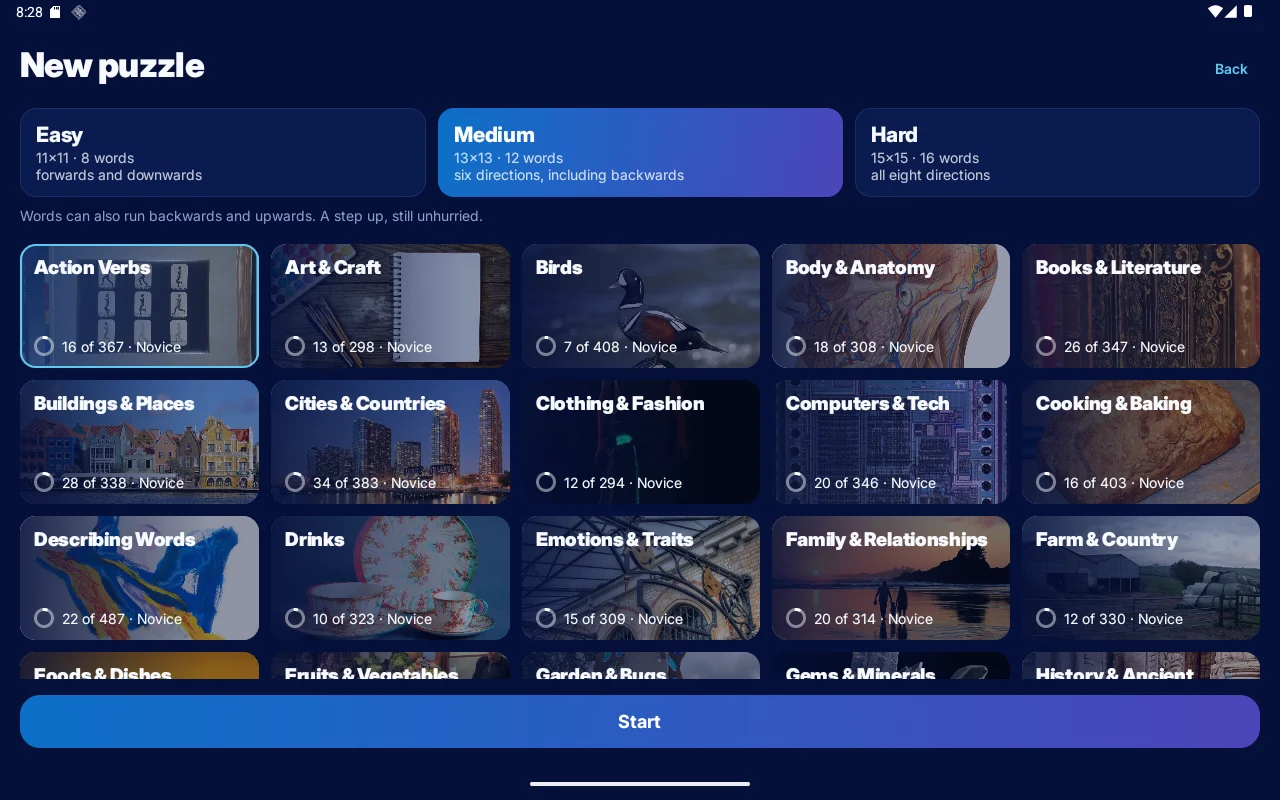
New puzzle
The three presets spell out exactly what changes — grid, word count, allowed directions — above a theme map showing how much of each category has been discovered.
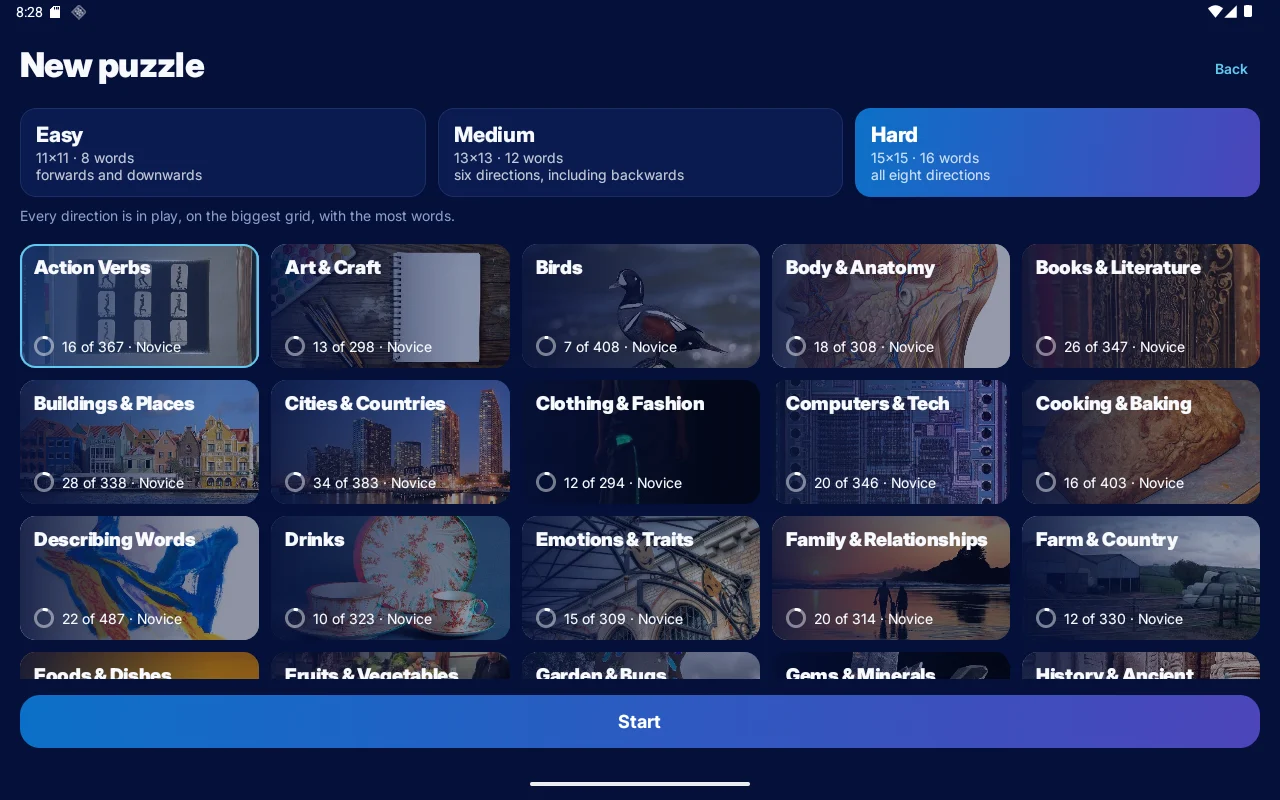
Hard selected
15x15, 16 words, all eight directions. Difficulty is a property of the grid; the vocabulary is identical at every level.
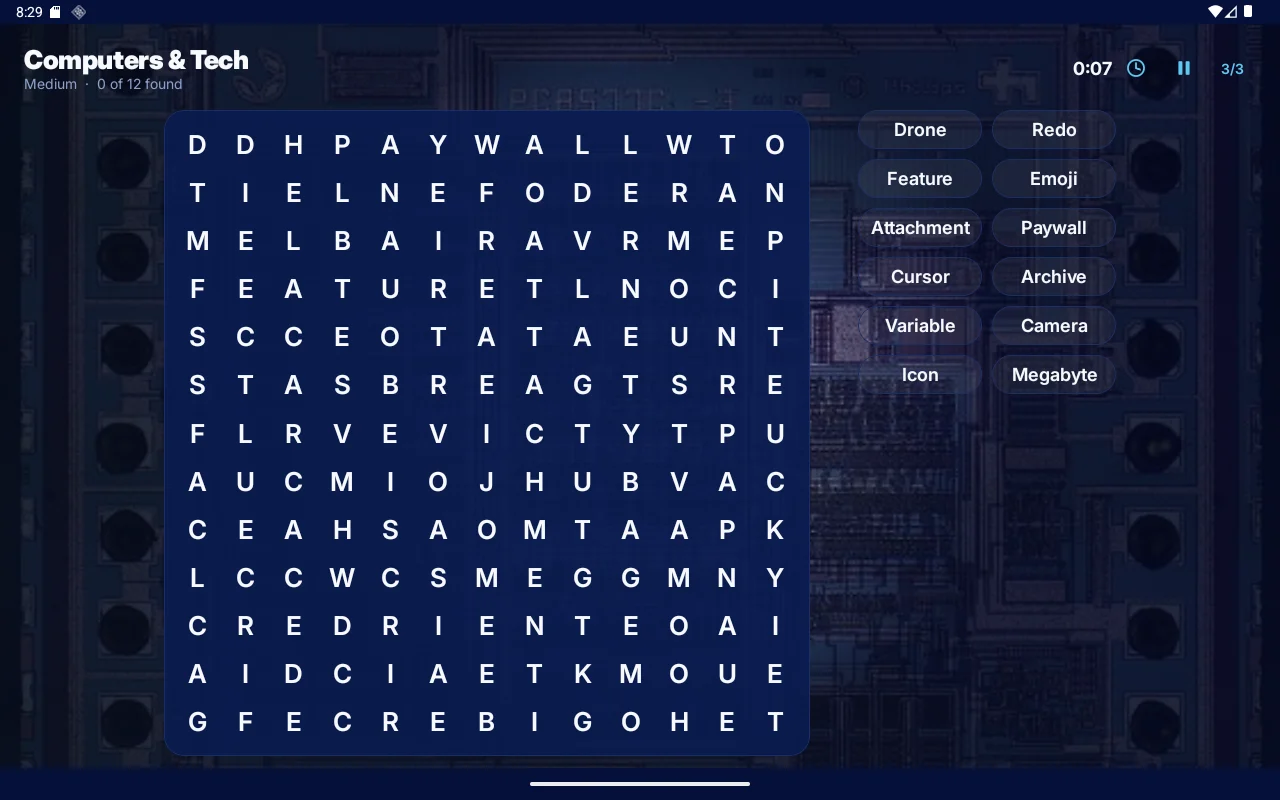
A fresh board
Grid centered and square, word bank as a right rail, hints and timer top-right. Filler letters are sampled from this theme's own letter frequencies.
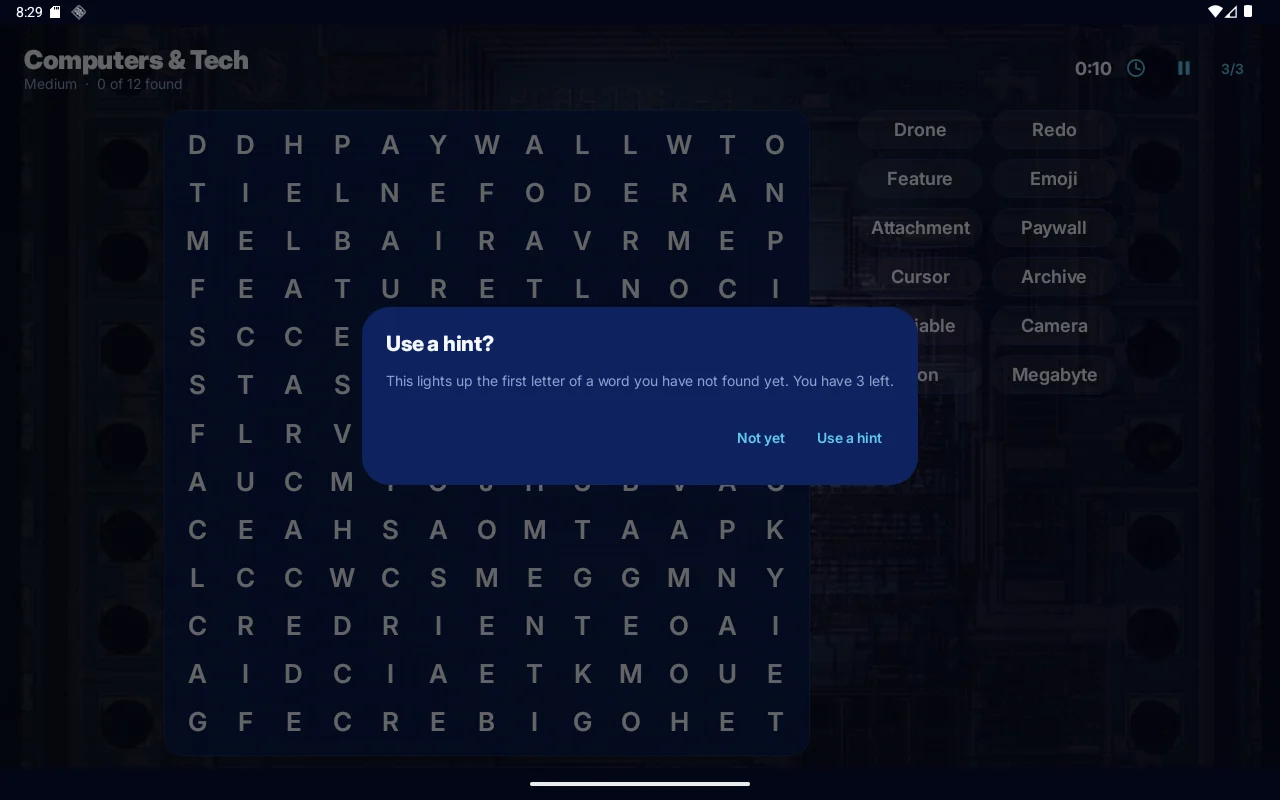
Hints
Three per puzzle by default, configurable to unlimited. A hint pulses the first letter of a random unfound word and costs nothing.
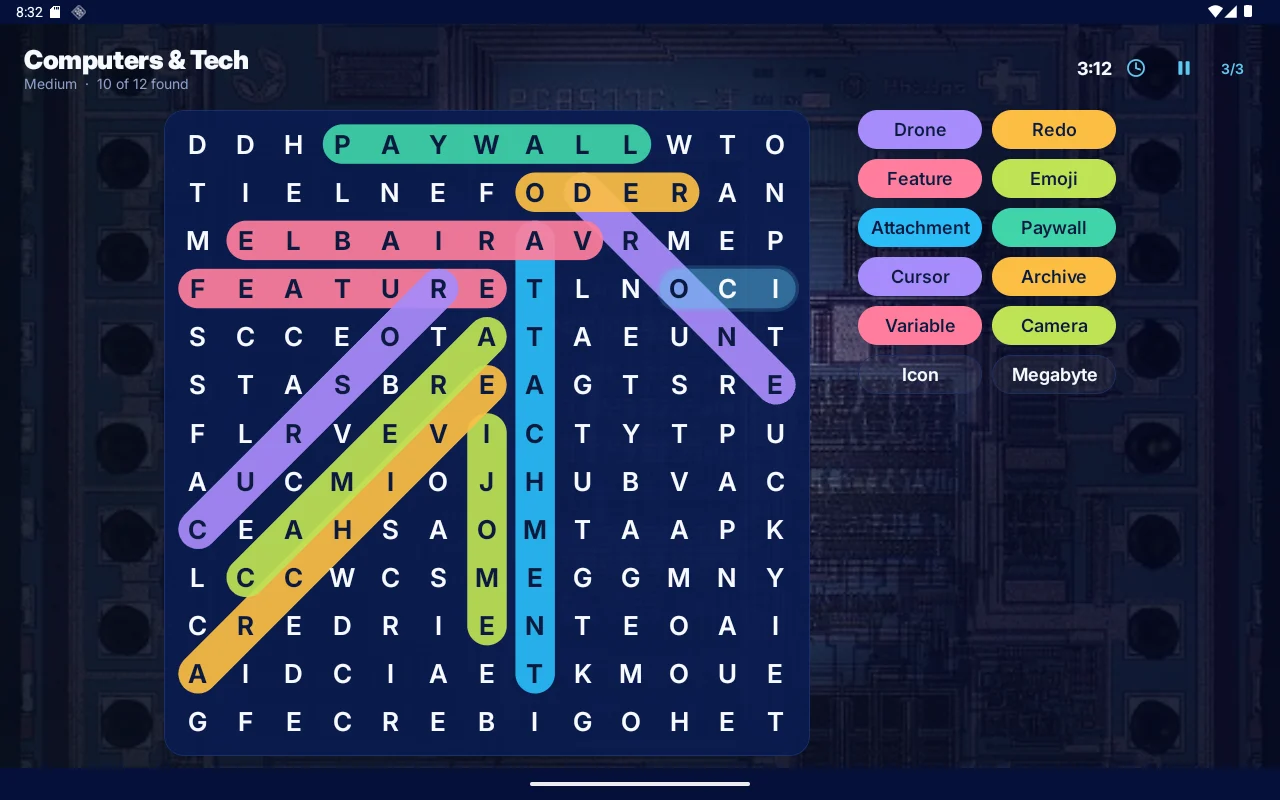
Partway through
Bands drawn near-opaque with the letters flipped to ink over them, and the matching bank chip filled — the grid and the list are two halves of one object.
Timer, Hints, and Pause
Three features that would each carry a penalty in a conventional puzzle game, and carry none here.
Timer
Small, hideable in Settings, and only ever compared against the player's own previous best for that theme and difficulty. Hiding it does not stop score, stats, or streaks from being recorded — it only removes the clock from view.
Hints
Three per puzzle by default, configurable including unlimited. A hint pulses the first letter of a random unfound word. It never blocks and never costs anything — though a hint-free solve is what the no-hint streak notices.
Pause
Blurs the grid so the tablet can be set down mid-puzzle without the player cheating themselves on the clock. There is nothing to lose by pausing and nothing to gain by not.
Completion
All words struck triggers a soft confetti of the band colours — about 1.2 seconds, never blocking input — then the completion card shows the progression payoff in a fixed order.
Score earned
With its breakdown — base, new-word bonus, no-hint bonus, speed bonus — counting up rather than appearing all at once.
Newly discovered words
“Six words you've never found before”, and the theme ring advancing to match.
Any milestone or streak crossed
One card at a time. This is where a trophy's artwork is seen for the first time.
Actions from there: New Puzzle (same theme and difficulty), Change Theme, or Home. This sequence is the emotional core of the meta-game. Everything before it is the puzzle; this is what makes finishing one feel like it added up to something.
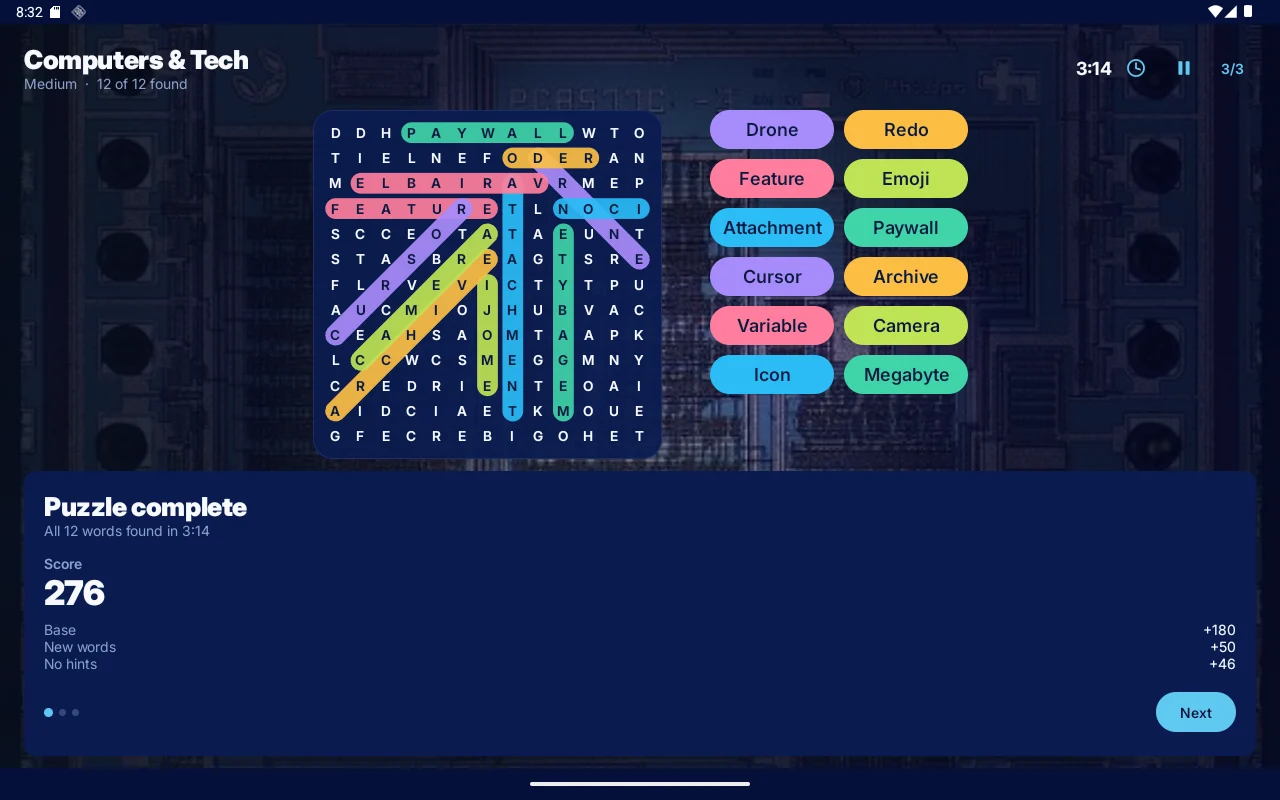
All twelve found
Six band colours cycling across twelve words, interleaved light and dark so neighbouring indices never collide. Later bands win the crossing cells, the way two highlighter passes actually look.
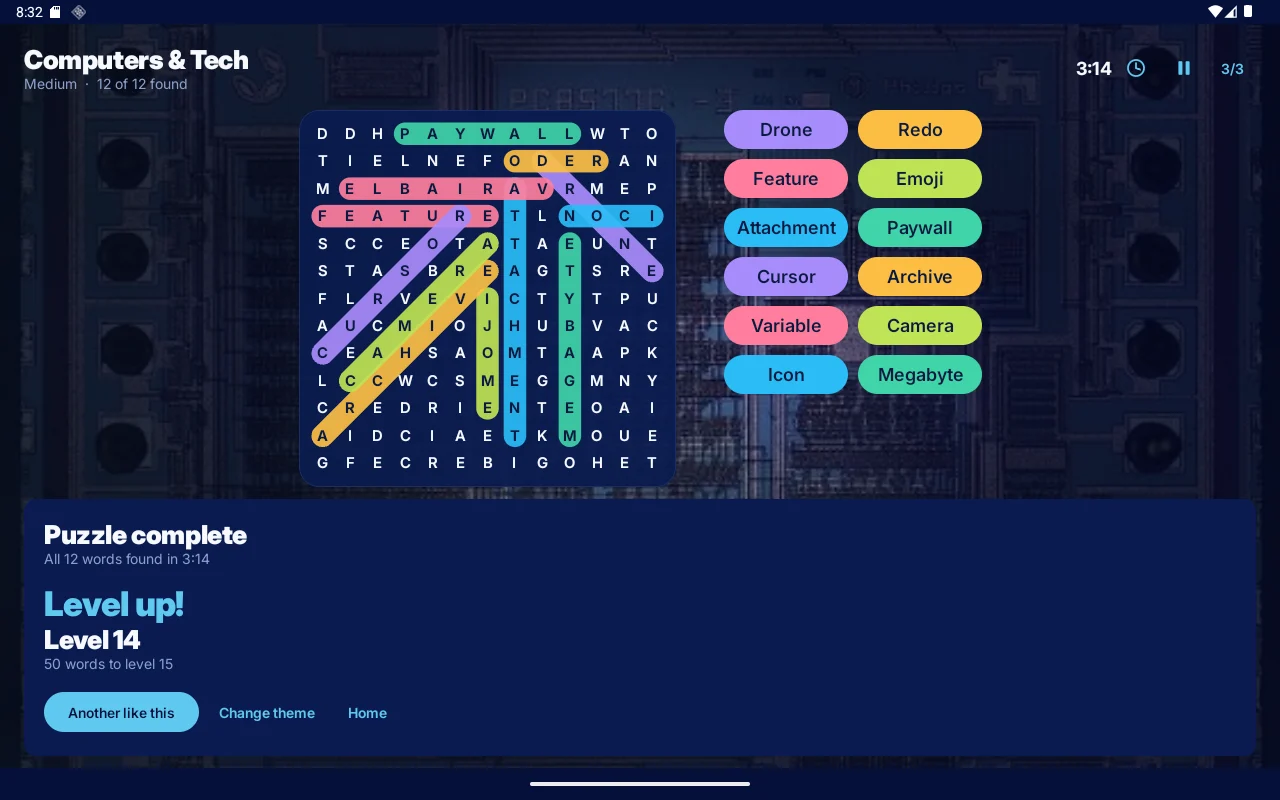
The payoff
Time and word count, then the progression beat — here a level-up, with how many words remain to the next one. Actions are another like this, change theme, or home.
The 32dp floor is a touch-target rule
Which is why it is lifted once a puzzle is complete — a finished board is looked at, not touched, and holding the floor there made the completion card push the grid off screen. The band colours are separated in lightness as well as hue so that a solved word is distinguishable under all common colour vision deficiencies, and a contrast test asserts every pairing around the cycle including the wrap, plus dark ink over every band.