 Labs
LabsFeatures
A detailed look at every capability of the Rdn.FacLT platform — from constraint-based booking engine to AI-powered workflow automation.
Booking Engine
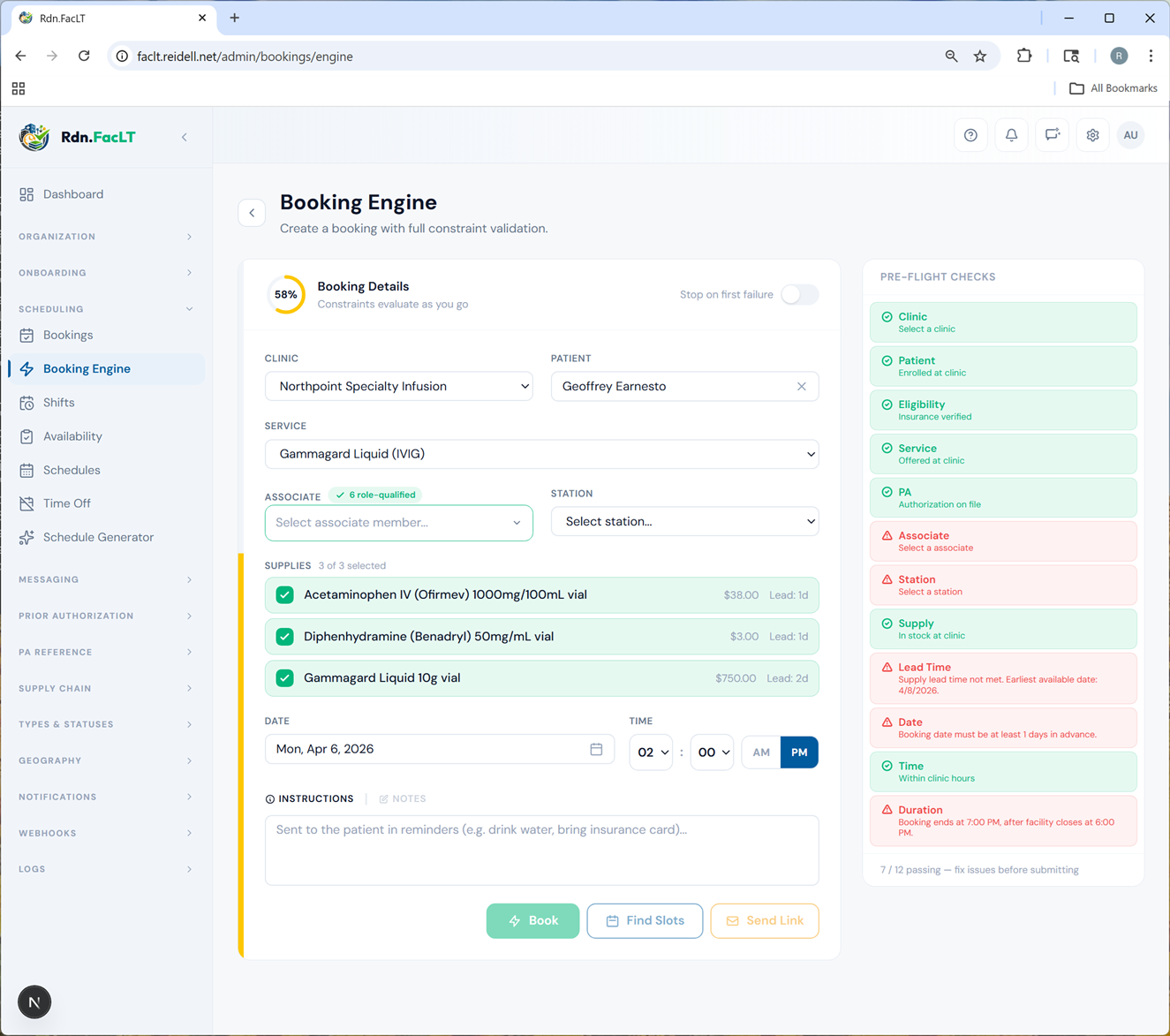
Constraint-Based Booking Engine
12-constraint validation chain evaluates scheduling, staffing, capacity, supply chain, insurance eligibility, prior authorization status, and compliance rules before confirming any appointment — with automated cost calculation.
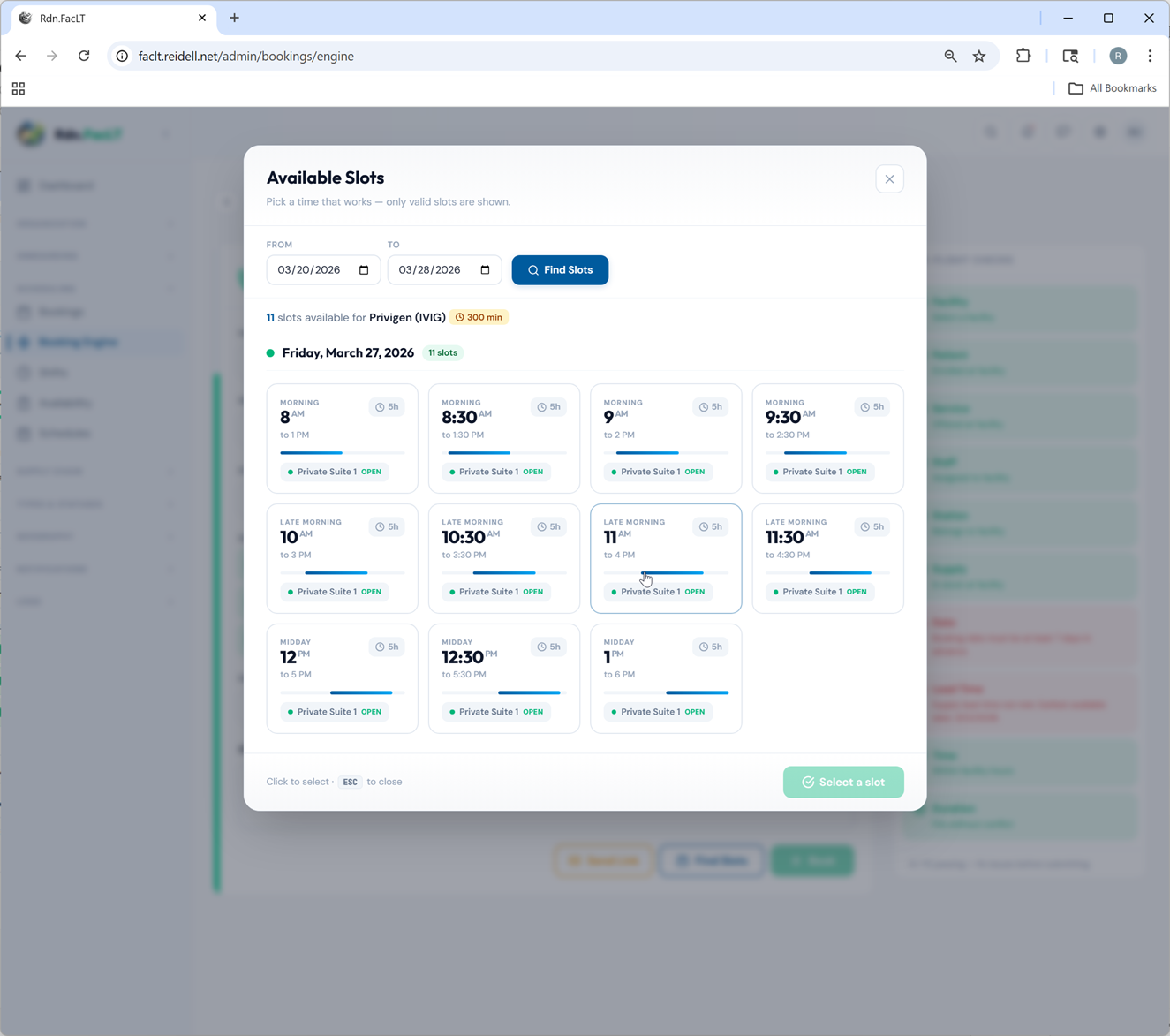
Slot Availability Picker
Time grid modal showing all available slots filtered by service duration, staff schedules, station capacity, and facility hours. Clients or staff select from validated time windows.
Booking Status Workflow
Full booking lifecycle from creation through completion with multiple status transitions. Every status change captured in an immutable audit snapshot.
Prior Authorization & Eligibility
Insurance eligibility verification and prior authorization status validated as booking engine constraints — PA and eligibility checks fire as soon as clinic, patient, and service are selected.
Scheduling & Shift Management
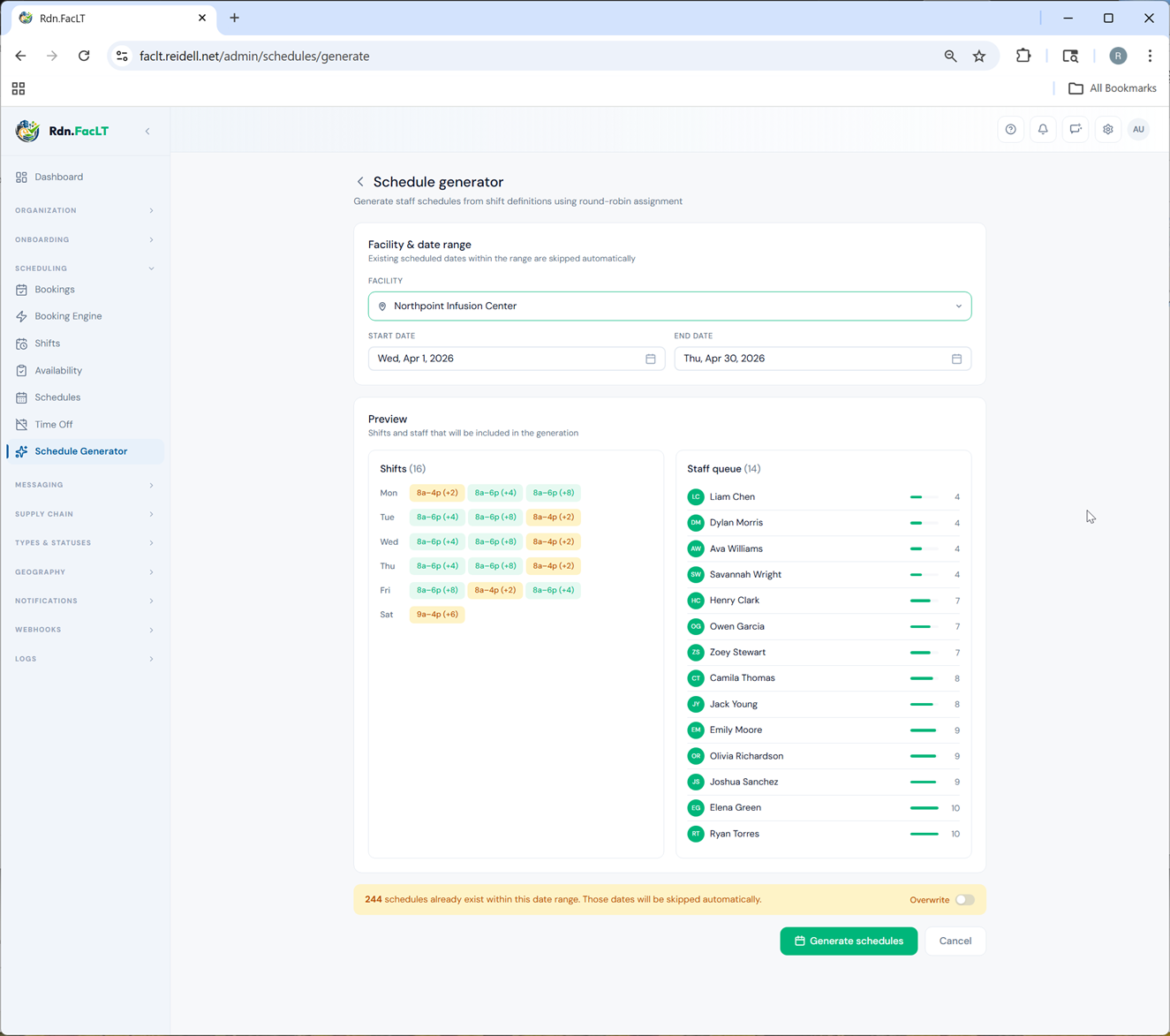
Schedule Generation Engine
Automated engine assigns staff to shifts based on role eligibility, availability windows, and seniority-weighted fairness metrics. Full audit trail tracks assignment history and ensures equitable distribution.
Shift Management
Facility-wide shift templates by day of week with role requirements. Morning, afternoon, all-day, and weekend shifts with automatic staff-role matching during schedule generation.
Time-Off Management
Staff time-off request workflow with submit, approve, deny, and cancel lifecycle. AI agent checks for booking conflicts and scheduled shifts before submitting, prompting the user to resolve overlaps.
Station Assignment
Treatment stations (chairs, rooms, bays) tracked per facility with booking-level assignment. Capacity constraints prevent overbooking treatment areas.
Prior Authorization & Insurance
PA Lifecycle Management
Full prior authorization workflow — create authorizations, submit requests (initial, renewal, urgent), track approvals with unit-based and date-based limits, manage multi-level appeals with deadlines and external review, assign tasks with priority and due dates, attach documents, and log notes. 30 API endpoint groups covering the complete PA domain.
Electronic PA (ePA)
FHIR-ready electronic submission via PriorAuthTransactions (X12 278/FHIR bundles), real-time status polling via subscriptions, DTR questionnaire integration for payer-specific documentation, CRD coverage decision responses, and clearinghouse configuration management.
Insurance & Payer Management
Payer registry with PayerTemplates for rapid onboarding (clone contacts, addresses, settings). PayerTypes (Commercial, Medicare, Medicaid), per-payer documentation requirements by procedure/diagnosis code, payer API endpoints, insurance plans, and patient insurance assignments with primary designation per facility.
Eligibility Verification
Automated insurance eligibility checking integrated into the 12-constraint booking engine. Validates active coverage, checks termination dates, surfaces stale eligibility warnings, and records verification history per client-facility-insurance combination.
Clinical Orders
Physician orders linking client, ordering provider, diagnosis code, procedure code, and service — the clinical justification that precedes prior authorization. Tracks order status, urgency level, and clinical notes.
Medical Code Catalogs
CMS HCPCS procedure code and ICD-10-CM diagnosis code import from official release files via CLI tool. Searchable code tables with inline toggle switches for RequiresPA and Active status. ServiceProcedureCodes link billable codes to services for PA requirement mapping.
Client Self-Scheduling & Onboarding
Booking Invites (Magic Links)
Secure single-use links sent via SMS, email, or push. Clients click to see available slots and confirm their appointment without creating an account.
Staff & Client Onboarding Wizards
Multi-step invitation flow: verify email, set password, complete profile, collect communications consent per channel, and accept terms.
Appointment Confirmation Flow
Token-based confirmation endpoint for anonymous booking confirmation. Expired tokens surface a clear re-invite prompt rather than a dead end.
Consent Collection at Signup
Every onboarding wizard includes per-channel consent collection with version-locked legal text. Communications policy screen gates progression.
Dashboards & Facility Management
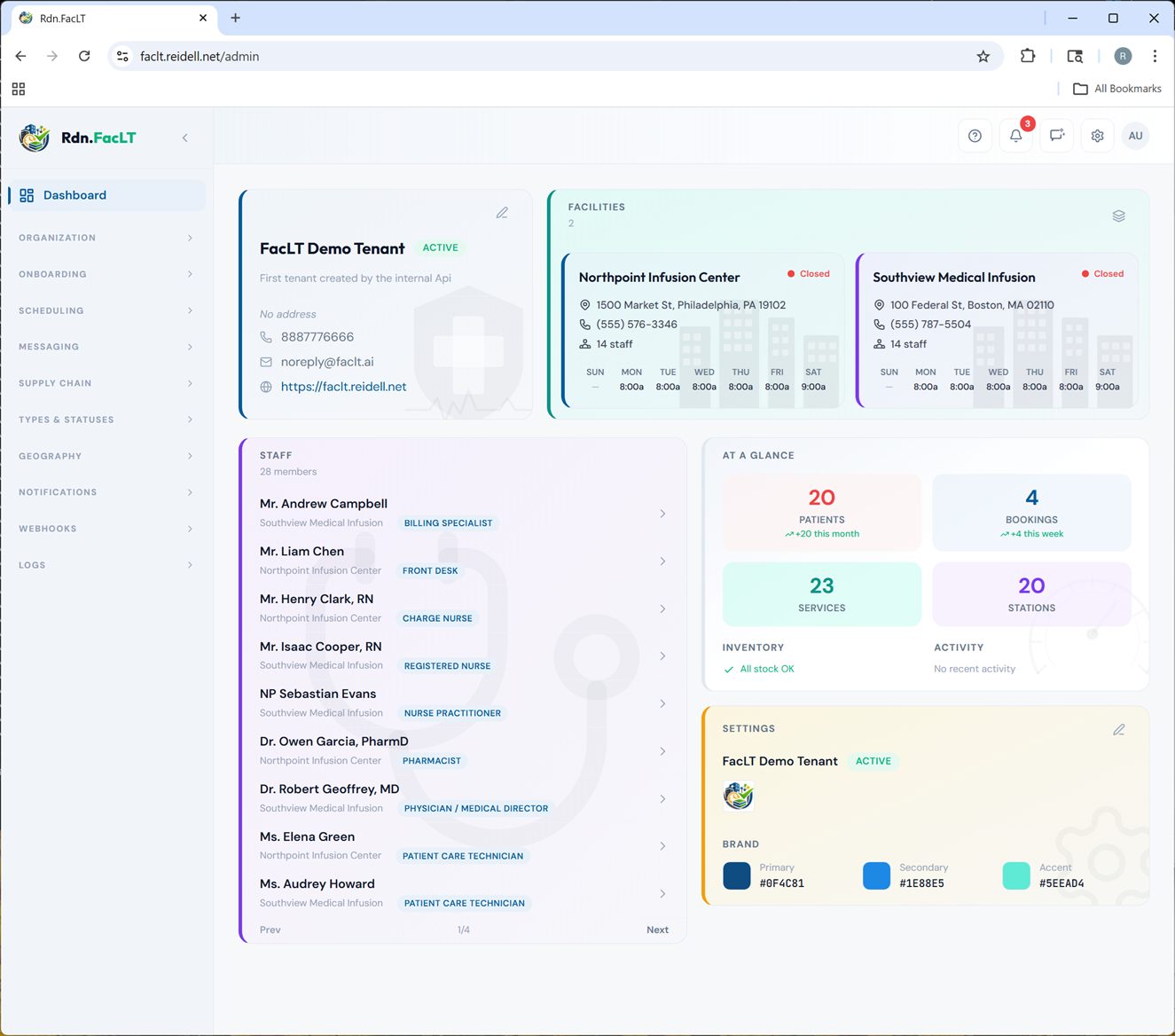
Tenant Dashboard Hub
Card-based organization overview showing tenant info with contact details, facility cards with address and station counts, staff roster with roles, and tenant settings — all real data, all clickable.
Facility Dashboard Hub
Facility-level hub with staff list, upcoming appointments, treatment stations, supply inventory with stock/reorder levels, service catalog, hours of operation, and facility settings.
Facility Settings & Constraints
Per-facility configuration for capacity limits, booking policies, lead times, cancellation rules, and operational parameters.
Tenant Branding
White-label customization with primary/secondary/accent colors, logo URL, favicon, company title, and welcome message. Branding cascades from API to web dashboard to native Android mobile apps.
Supply Chain
Facility Supply Inventory
Per-facility stock tracking with current levels, reorder levels, and reorder quantities. Inventory feeds directly into booking engine constraint validation.
Lead Time Awareness
Track procurement lead times in days per supply. The booking engine computes earliest bookable date when supply lead time exceeds available stock window.
Service-Supply Linking
Define required supplies and quantities per service. When a booking is confirmed, inventory is automatically decremented by the required amounts.
Tenant Catalog & Shelf Life
Tenant-wide supply catalog with shelf life, pricing, and supplier relationships. Facility inventory draws from the catalog for local stock management.
Client & Staff Management
Client Records
Full client profiles with demographics, date of birth, gender, configurable status, facility enrollment, and booking history across all facilities.
Staff with Role-Based Service Eligibility
Staff profiles with hire/termination dates, hourly rates, contractor status, and role assignments. Roles are linked to service categories for booking eligibility.
Service Catalog
Services organized by type with pricing, duration, and per-facility overrides. Each facility can customize pricing and duration for its specific needs.
Contact Information System
Shared address, email, and phone management across all entity types with type classifications. Full CRUD with collapsible form sections.
Notifications & Two-Way SMS
Multi-Channel Delivery
Template-driven notifications via Email, SMS, WhatsApp, and Push. Dual provider strategy for SMS redundancy.
Two-Way SMS with Keyword Handling
Inbound message processing handles compliance keywords first, then application-specific responses. Request signature validation on every inbound message.
HIPAA-Compliant Consent Ledger
Append-only consent records per client, per channel, per communication class. Version-locked legal text with full forensic trail for compliance audits.
Notification Audit & Correlation
Every outbound message logged with recipient, template, channel, content, and success status. Outbound message ledger enables reply correlation for inbound keyword matching.
Mobile Apps
Staff App
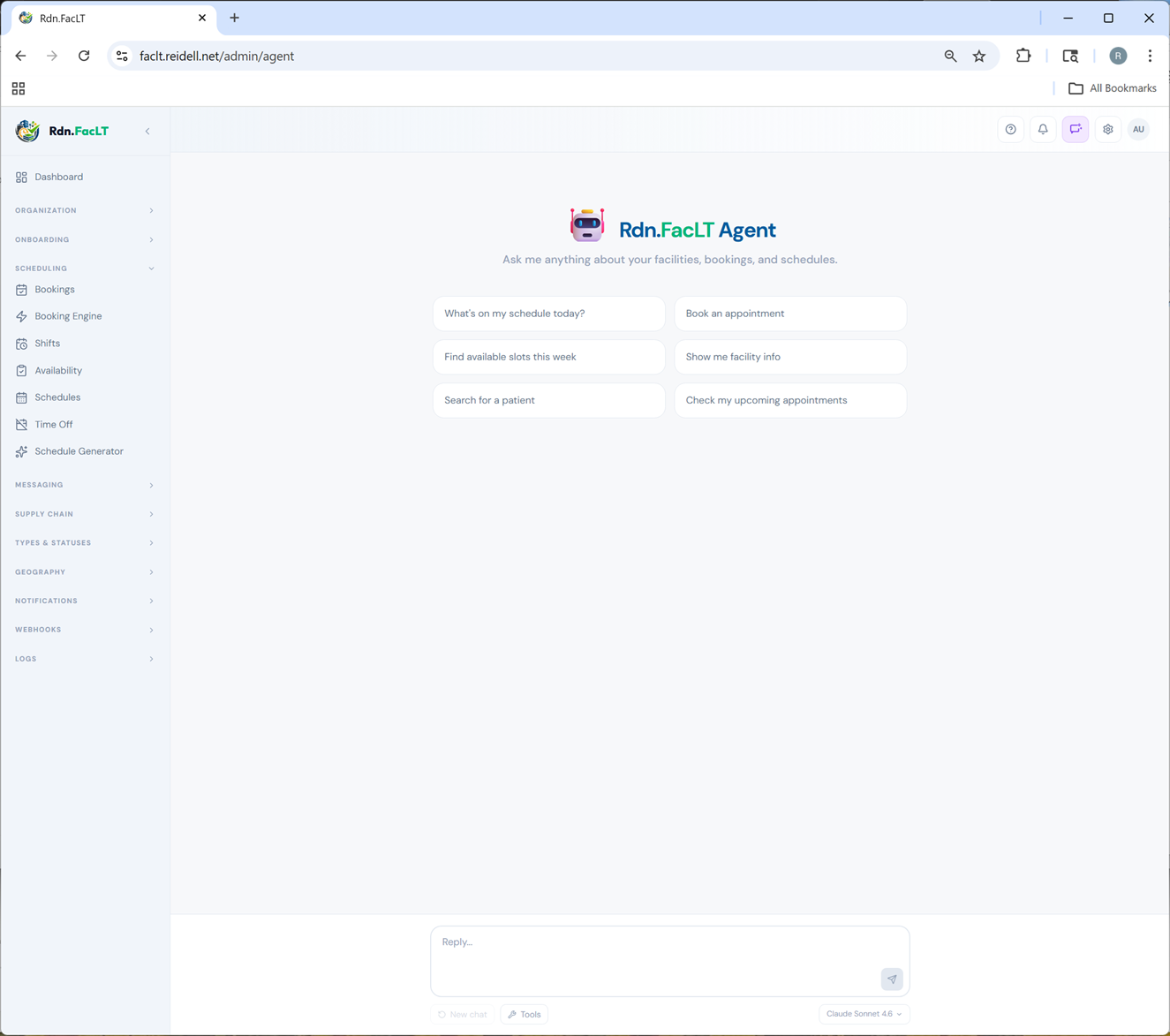
Native Android app with dashboard, bookings with status actions, weekly schedule, three-channel messaging (client inbox, staff channel, broadcasts), AI agent chat, client search, and push notifications. Direct API auth with MFA.
Client App
Native Android app with dashboard, appointment viewing, secure messaging with clinic staff (date-grouped, read receipts), push notifications with deep linking, and profile management.
In-App Messaging
Three-channel messaging system: client inbox with SMS-style conversations and staff-only notes, staff channel for facility-wide group chat, and broadcasts for tenant-wide announcements. Directional messaging events with batch read patterns.
Native Android with Material 3
Built with Kotlin, Jetpack Compose, and Material 3 design system. Modern dependency injection, type-safe networking, push notifications, and secure token storage.
AI Agent & MCP Server
515 AI Tools (477 Entity + 34 Workflow + 4 Utility)
Full CRUD coverage across 96 entity types plus 34 purpose-built workflow tools for booking, scheduling, administration, diagnostics, and demo environment seeding — all identity-aware.
MCP Server
Full API parity across 96 entity types for external MCP clients (Claude Code, Cursor). 477 entity operations with parameter validation, safety guards, and detailed descriptions.
Specialty-Aware Seed Data
Six seed/generate workflow tools create realistic demo environments for infusion clinics, cancer centers, and medspas with staffing matrices by facility size, specialty-specific roles, and heuristic-driven staff allocation.
SSE Streaming & Model Selection
Real-time streaming responses with tool call visualization (running, success, error). Per-conversation model selection from available Claude models. Auth token passthrough to every tool call.
Webhooks & Event-Driven Integrations
Tenant-Scoped Webhook Subscriptions
Subscribe to domain events per tenant with configurable endpoint URLs, signed payloads, and subscription lifecycle management through admin UI and API.
67 Event Types Across 23 Categories
67 event types across 23 categories — Bookings, Staff, Clients, Facilities, Shifts, Schedules, Stations, Services, Availability, Hours, Settings, Inventory, Consent, Onboarding, Devices, Notifications, Messaging, and TimeOff — Created, Updated, Deleted, and StatusChanged variants.
Delivery Retry with Audit Trail
Every delivery attempt is tracked with status code, response body, attempt count, and timestamps. Failed deliveries are retried with backoff.
Webhook Delivery Log Viewer
Dedicated admin log viewer with expandable row details showing delivery attempts, response payloads, and event correlation. Test webhook endpoint for subscription verification.
Audit & Compliance
6 Audit Log Viewers
Read-only log viewers for Bookings, Schedules, Shifts, Notifications, System events, and Webhook Deliveries. Immutable snapshot logs capture full entity state at every status change.
Schedule Generation Traceability
Every generated schedule assignment produces a correlated audit record, linking all assignments from a single generation run for compliance review and traceability.
Data Protection Encryption
Sensitive fields encrypted at rest with automatic key management. Booking invite tokens encrypted using platform-native key storage.
Types & Statuses Configuration
Quick-reference lookup grid for all configurable system types, statuses, and classifications used throughout the platform.
Explore More
Dive into other areas of the platform.
Overview
Platform overview, tech stack, and project summary for the full FacLT scheduling system.
Architecture
Eight-project architecture, 133 domain entities, CQRS layers, 95 API endpoint groups, 309 web components, and native mobile apps.
MCP & Agent
515 tools (477 entity + 34 workflow + 4 utility) with purpose-built API endpoints, MCP server, SSE streaming, and JWT identity resolution.
Mobile
Native Android apps for staff and patients built with Kotlin and Jetpack Compose, powered by the same REST API and MCP server.